Universal or Specialized Treatment Rooms: How to Allocate Workplaces by the Numbers
Universal rooms are usually more profitable when demand for services fluctuates strongly, and specialized ones when demand is stable and equipment is…
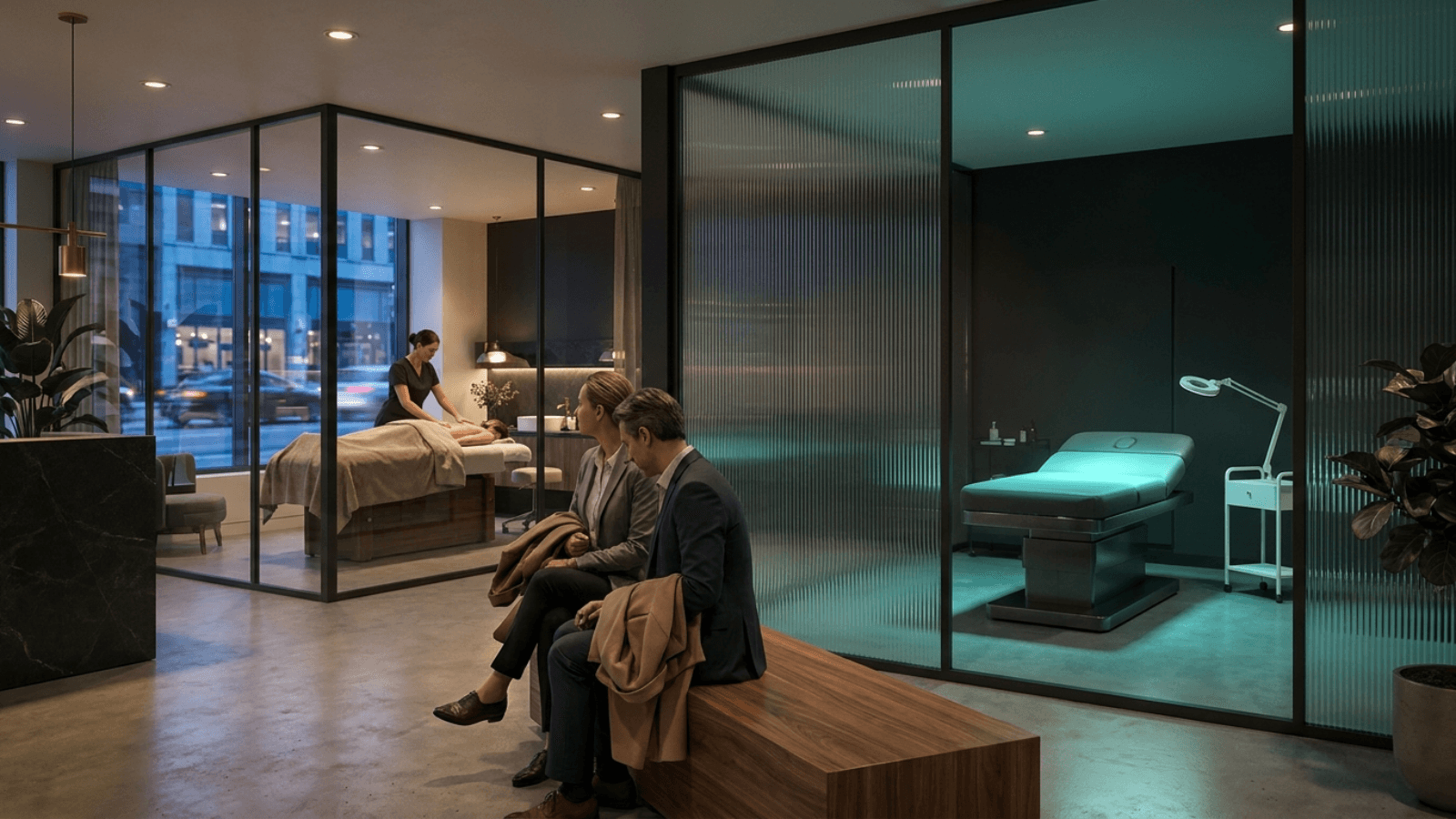
Universal rooms are usually more profitable when demand for services fluctuates strongly, and specialized ones when demand is stable and equipment is expensive. The choice comes down to comparing two amounts: the profit from clients for whom specialized rooms have no free time, and the cost of an additional set of equipment for the universal one.
Below we calculate both amounts using a studio with two rooms as the example. We will see how many hours are missing in specialized rooms, how much universality costs and how many busy months a year it takes to justify it. We call a month busy when more clients want to book a service than its room can take.
In plain terms. Imagine a school with two classrooms. In one, math is always taught, in the other, literature, and each has the textbooks needed exactly there. If there are twice as many math students, one classroom is crowded and the other is half empty. You can make both classrooms universal, and then everyone uses the free space, but each will need textbooks for both subjects. With treatment rooms we choose between the same two options.
Two approaches to allocating rooms
First we describe both approaches, then move on to the calculation.
Universal room
Any service from your price list can be performed in it. For this, every room needs a full set of equipment. Such a setup is flexible: when demand for one service grows, it can be performed in any free room, and total capacity is used more evenly.
Specialized room
The room is equipped for one service or a group of services. There is one set of equipment, the fit-out is usually better suited, and the break between clients is shorter, because no reconfiguring is needed. The drawback is that the room's capacity cannot be used for other services: if demand fell, the room stands idle, and if it grew, some clients have nowhere to be taken.
Starting data for the example
Take a studio with two rooms. The schedule is 25 working days of 8 hours, so each room has 200 hours per month, 400 hours in total. The studio offers two services: massage and facial.
A massage costs $100. It takes 50 minutes, plus 10 minutes of break, so the room is occupied for 60 minutes. The therapist is paid 40% of the price, $40, and materials cost $10. The contribution profit from one massage is 100 − 40 − 10 = $50, that is, $50 per room hour.
Demand for massage is the number of hours clients want to book. In quiet months it is 160 hours, in busy ones 240. Demand for facials is stable, 60 hours. The universal setup needs a second set of massage equipment in the facial room and a facial set in the massage room. Together they cost $30,000 and last 5 years, that is, 60 months, which gives $500 per month.
How many hours are missing in a busy month
Let's calculate step by step. First we look at the specialized setup, where the first room does only massage and the second only facials.
Step one: a quiet month. Demand for massage is 160 hours, and the room can take 200. All demand is served, and the utilization of the massage room is 160 ÷ 200 = 80%. The facial room takes 60 hours out of 200, that is, 30%.
Step two: a busy month. Demand for massage is 240 hours, and the room can take only 200. Clients are booked for 200 hours, and the massage room is 100% full. For the remaining 240 − 200 = 40 hours there is no free time in it, although the neighboring room has 140 free hours.
Step three: the universal setup. Both rooms can do massage, so all demand of 240 + 60 = 300 hours is served. Total utilization is 300 ÷ 400 = 75%.
Indicator | Quiet month | Busy month |
Massage demand, hours | 160 | 240 |
Facial demand, hours | 60 | 60 |
Specialized: massage hours booked | 160 | 200 |
Specialized: massage hours missing | 0 | 40 |
Specialized: utilization of the massage room | 80% | 100% |
Specialized: utilization of the facial room | 30% | 30% |
Specialized: total utilization | 55% | 65% |
Universal: total hours booked | 220 | 300 |
Universal: total utilization | 55% | 75% |
The main point is visible in the table. In a quiet month both setups serve all demand, so the universal one adds nothing. In a busy month it takes 40 more hours of massage, and the studio earns extra on this difference.
Careful. The total utilization of 65% in the specialized setup in a busy month hides an imbalance: one room is 100% full, the other 30%. It is useful to look at the utilization of each room separately: this shows that one place is full even though the studio average is moderate.
How much universality costs
The additional 40 hours of massage in a busy month bring 40 × 50 = $2,000 of contribution profit. Against this stands the additional set of equipment, which costs $500 per month and is paid every month, whether the month is busy or not.
Annual gain from universal rooms = Additionally sold hours × Contribution profit per hour − Annual cost of additional equipment
The result depends on how many busy months there are in a year. The annual cost of the additional set is 500 × 12 = $6,000. Each busy month brings $2,000. So we can calculate the minimum number of busy months.
Minimum busy months = Annual cost of additional equipment ÷ (Missing hours per month × Contribution profit per hour)
Plugging in: 6,000 ÷ (40 × 50) = 3. If there are three busy months, both setups give the same result. If there are more, the universal setup is more profitable; if fewer, the specialized one.
Busy months per year | Additional contribution profit | Cost of the additional set | Result of the universal setup |
1 | $2,000 | $6,000 | −$4,000 |
3 | $6,000 | $6,000 | $0 |
5 | $10,000 | $6,000 | +$4,000 |
Check: for five months, 5 × 2,000 equals $10,000, minus $6,000 of costs gives $4,000. For one month, 2,000 − 6,000 = −$4,000, that is, the equipment costs exceed the additional profit by $4,000. The numbers add up.
Picture Bohdan. He has a studio with two rooms and notices that the massage room fills up completely in three months of the year, while the rest of the time the second room is half empty. Bohdan calculates: three busy months give $6,000 of additional profit, and the second set of equipment costs $6,000 a year. The setups are equal, so he looks at other factors: will demand for massage grow further, can equipment be moved between rooms. The decision is his, and he sees the difference in numbers.
What else affects the choice
The calculation above takes into account only profit from hours and the cost of equipment. There are several factors worth adding to the comparison.
Factor | Universal rooms | Specialized rooms |
Equipment | Two sets, higher cost | One set, lower cost |
Peak months | Take all demand within capacity | Limited by the capacity of one room |
Break between clients | Longer when reconfiguring is needed | Shorter, because the setup is constant |
Workload of the rooms | More even across rooms | May be uneven |
New service line | Easy to add to existing rooms | Needs a new or refitted room |
A separate word on reconfiguring. If a universal room needs more preparation time between different services, the break has to be increased. For example, instead of 10 minutes it is 20. Then the room is occupied 70 minutes per visit, and in a month (200 hours × 60 = 12,000 minutes) you can take 12,000 ÷ 70 ≈ 171 visits instead of 200. This is capacity worth accounting for when you compare the setups.
There is also the quality of the client experience. In a specialized room it is easier to maintain the atmosphere, cleanliness and order that fit the service. This factor is not measured in dollars, but it may matter a lot to you, and then it shifts the decision toward the specialized setup even when the numbers are equal.
An intermediate option
There is also a third option. The first room stays for massage, while the second becomes universal: it gets a second set of massage equipment and keeps taking facials. The additional cost here is only the massage set. For the example, it costs half of $30,000, that is, $15,000 over 5 years: 15,000 ÷ 60 = $250 per month and $3,000 per year.
The surplus massage in a busy month still goes to the second room, where 140 hours are free, so the additional 40 hours of profit stay the same. The minimum number of busy months is now 3,000 ÷ (40 × 50) = 1.5. In other words, two busy months a year already justify this option: 2 × 2,000 = $4,000 against $3,000 of costs. It is cheaper than full universality and takes the same additional 40 hours of massage, so it is worth calculating together with the other two.
How to assemble your own starting data
The comparison needs three numbers. The first: demand for each service in hours for the months of the last year. It is visible from your records and sales log. The second: the contribution profit per hour of each service, that is, the price minus pay and materials, divided by the time the room is occupied. The third: the cost of the additional set of equipment divided by its service life in months.
It is convenient to treat a month as busy if demand for a service exceeds the capacity of one specialized room. In the example this is massage above 200 hours. If refusals are not recorded yet, you can start with a simple list of refusals and wishes: requests for which there was no free slot. After a few months it will show how many hours of demand you did not take, and that is already enough for the calculation.
How to compare the setups with your own data
A manual calculation works for two rooms and two services. When there are more rooms and services and demand changes, it is more convenient to see the workload of each room at once.
In BizCalc, you will be able to create each room as a workplace in the «Workplaces» section. You will be able to attach services to workplaces in the «Services» section, where you will specify for each service where it is performed. One service can be attached to several workplaces. The type of room will depend on which services you attach to it: if all of them, the room is universal; if one service or a group, it is specialized.
You will be able to change the order of workplaces by dragging cards. When a service is attached to several workplaces, the one with the lower number will fill first, and the remaining bookings will move on to the next. If a room works different hours, you will be able to turn on the «Individual» schedule for it.
On the «Workload: Sales» page, each workplace will have its own circle with the share of occupied hours. On the «Workload: Forecast» page, you will be able to increase sales of all services by the same percentage (global simulation). When one workplace is 100% full, it will stay full while growth continues on the others. This will show which room runs out of free time first. You will be able to enter the equipment cost per month in the «Fixed Costs» section. In the example it is $500 with a period of one month.
Some things we cannot do yet: link an employee or a salary to a workplace, or duplicate a workplace together with its schedule and services (it has to be created anew). The «Individual» schedule settings will not be kept if you switch to «General» and back.
What to remember
The choice comes down to two amounts. The profit from clients for whom specialized rooms have no free time is compared with the cost of an additional set of equipment.
Each room is assessed separately. The average utilization hides that one room is 100% full and another 30%.
The minimum number of busy months sets the limit. The annual cost of additional equipment divided by the additional profit of one busy month shows from how many busy months the universal setup is justified.
Reconfiguring reduces capacity. A longer break between different services reduces the number of visits a room can take in a month.
Atmosphere matters too. The quality of the client experience is not measured in dollars, but it can shift the decision toward a specialized room.
Frequently asked questions
How does a universal room differ from a specialized one?
In a universal room any service can be performed, so every room needs a full set of equipment. A specialized room is equipped for one service or a group of services, there is one set, and its capacity is used only for those services.
When are specialized rooms better?
Specialized rooms are more profitable when demand is stable, equipment is expensive and an additional set does not pay back. Then few clients are left without a free slot, and the savings on equipment are noticeable.
When are universal rooms better?
Universal rooms are more profitable when demand for services fluctuates strongly by month, and the profit from clients left without a free slot in busy months is higher than the cost of the additional equipment. To check this, it is useful to calculate the minimum number of busy months.
How do I tell that a room is short of capacity?
It is useful to look at the utilization of each room separately. If one room is constantly about 100% full and some clients have nowhere to be taken, that is a signal that capacity is short exactly there.
Should equipment depreciation be taken into account?
Yes, the monthly share of the equipment cost (depreciation) is part of the costs. In the example, $30,000 over 5 years gives $500 per month, and this is the amount compared with the additional profit.
What if demand is seasonal?
It is worth calculating quiet and busy months separately and finding the minimum number of busy months for the additional set to pay back. If there are fewer real busy months, the specialized setup is more profitable.
Find out what your service really costs
Enter your schedule, workplaces, materials and expenses - and you will see the cost price of every service, your workload and your profit.