The Break Between Customers: What It Costs and How to Factor It into a Service Price
The break between customers costs as much as the workstation costs for those minutes: the length of the break multiplied by the cost per minute. That's why…
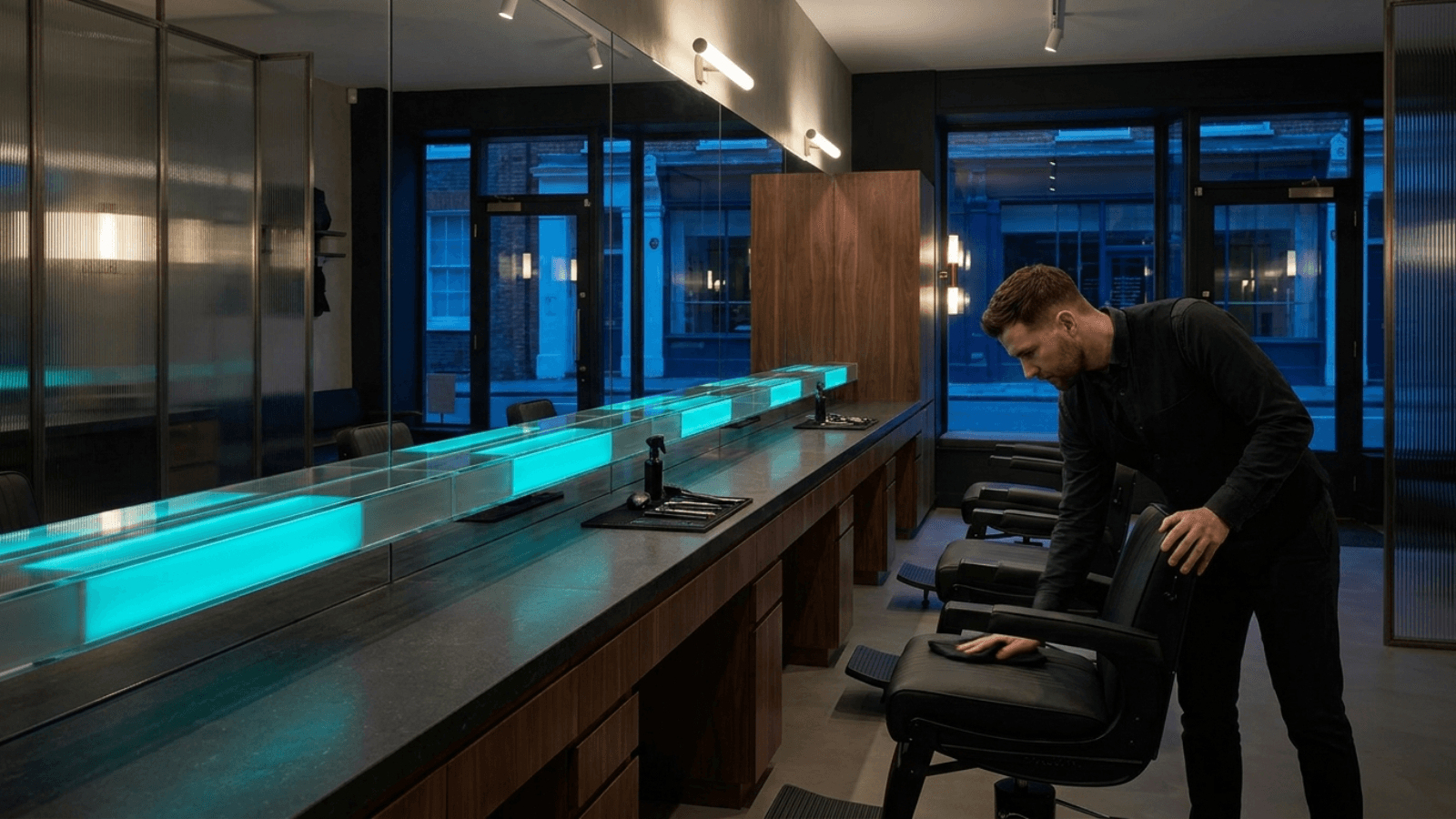
The break between customers costs as much as the workstation costs for those minutes: the length of the break multiplied by the cost per minute. That's why cutting a break by a few minutes adds up to a noticeable amount over a month, and a break that isn't accounted for reduces the profit of every service.
Let's go through what goes into a break, how to calculate its cost, and how many customers fit into a day. Why a break is part of the price calculation at all is covered in the article on pricing. Here we calculate what it costs.
In plain terms. Picture a taxi. The car drives with a passenger, then sits at a turnaround while the driver looks for the next fare. The passenger pays only for the ride, but the driver loses the time at the turnaround too. So the driver calculates the fare to cover those minutes as well. The break between customers works the same way.
What goes into a break
A break is everything that happens between two customers while the place can't take the next one. Usually that's cleaning, disinfecting, preparing materials, settling up with the customer, and booking the next visit.
Its length depends on the service. After a haircut, the hair has to be swept up, and after a procedure with instruments, the sterile sets have to be replaced. So the break is set for each service separately.
What one break costs
A break costs as much as the workstation costs for those minutes. The cost per minute is calculated the same way as in the article on pricing: overall costs for the month divided by the minutes sold.
Break cost = Break minutes × Cost per minute
Picture a studio. The cost per minute is $0.50 (overall costs of $6,000 a month and 12,000 minutes sold). A service lasts 60 minutes, and the break after it is 15 minutes. In a month, 120 such services are performed.
Step one: the cost of one break. 15 × $0.50 = $7.50. Each service carries this amount on top.
Step two: the cost per month. $7.50 × 120 = $900. That's what the breaks cost in a month.
Step three: what a shorter break would give. If, after training or a change in organization, the break shrinks to 10 minutes, it will cost 10 × $0.50 = $5, which is $2.50 less. Over a month, that's $2.50 × 120 = $300.
The $300 figure shows how much you could free up. A break is needed for cleanliness and so the next customer doesn't wait, so it isn't cut down to zero.
How many customers fit in a day
A break affects both the cost and the number of customers. Let's take a working day of 8 hours, which is 480 minutes, and a 60-minute service.
Break | One service occupies the place | Customers per day |
20 minutes | 80 minutes | 6 (480 ÷ 80) |
15 minutes | 75 minutes | 6 (480 ÷ 75 = 6.4) |
10 minutes | 70 minutes | 6 (480 ÷ 70 = 6.9) |
5 minutes | 65 minutes | 7 (480 ÷ 65 = 7.4) |
The number of customers is counted in whole numbers: a seventh customer fits only when seven services together with breaks fit into 480 minutes. So cutting the break from 20 to 10 minutes doesn't add a single customer, even though it lowers the cost of each service. A seventh customer fits when the break is no longer than 8 minutes: in the table, that's the 5-minute option.
The practical conclusion: before shortening a break, it's convenient to calculate whether it will add a customer. If not, the gain is only a lower cost of the service, and it's small.
How to determine your own break
It's convenient to measure a break. To do that, take ten customers in a row and write down how many minutes passed from the end of one service to the place being ready for the next. The average gives you your break.
It's convenient to round the result to the nearest 5 minutes. If the calculation assumes a 10-minute break but it's really 15, every service costs more than calculated, and the difference can go unnoticed until the schedule fills up.
How to calculate this from your own data
In BizCalc, the break is entered for each service separately in the “Services” section, right next to the price, duration, and the specialist's pay. The duration together with the break shows how much place one service occupies, and a share of overall costs lands on that time.
The schedule and workstations set your capacity, and the utilization forecast determines how many sales split overall costs between them. So you can change the break in one service and immediately see how its cost and the “Profit” column changed.
What's worth remembering
A break is occupied time. While the place is being cleaned, it doesn't take a customer.
The cost of a break is simple to calculate. Break minutes multiplied by the cost per minute.
The difference accumulates. $2.50 per service turns into $300 a month at 120 services.
Customers are counted in whole numbers. Cutting a break doesn't always add a customer.
It's better to measure a break. Ten visits in a row give an average you can use in the calculation.
Frequently asked questions
How long should a break between customers be?
There's no single norm, it depends on the service. It's convenient to measure it over ten visits: from the end of one service to the place being ready for the next.
How do you calculate the cost of a break?
Multiply the break minutes by the cost per minute. At a cost per minute of $0.50, a 15-minute break costs $7.50.
Is the break part of the service duration?
In the price calculation, yes: the service occupies the place for the whole time including the break, and a share of overall costs lands on that time. For the customer, it lasts only its own time.
Is it worth shortening the break?
If it gives an extra customer a day, the gain is noticeable. If not, the gain is only a lower cost of the service, and there's no point in cutting the break to zero.
Can the break differ between services?
Yes, and that's normal. It's set for each service separately, because cleaning and preparation after different services take different amounts of time.
How does the break affect profit?
Through the share of overall costs: a longer break increases the time for which the service pays for the place, so profit goes down.
Find out what your service really costs
Enter your schedule, workstations, materials and expenses - and you will see the cost price of every service, your workload and your profit.